Can you use paint on something you’re going to put outdoors?
Technically, yes.
But if you’re making an outdoor mosaic that you want to last, there’s a much more useful question to ask:
How is that paint going to look after months — or years — outside?
Earlier this year I decided to test exactly that.
My outdoor paint experiment
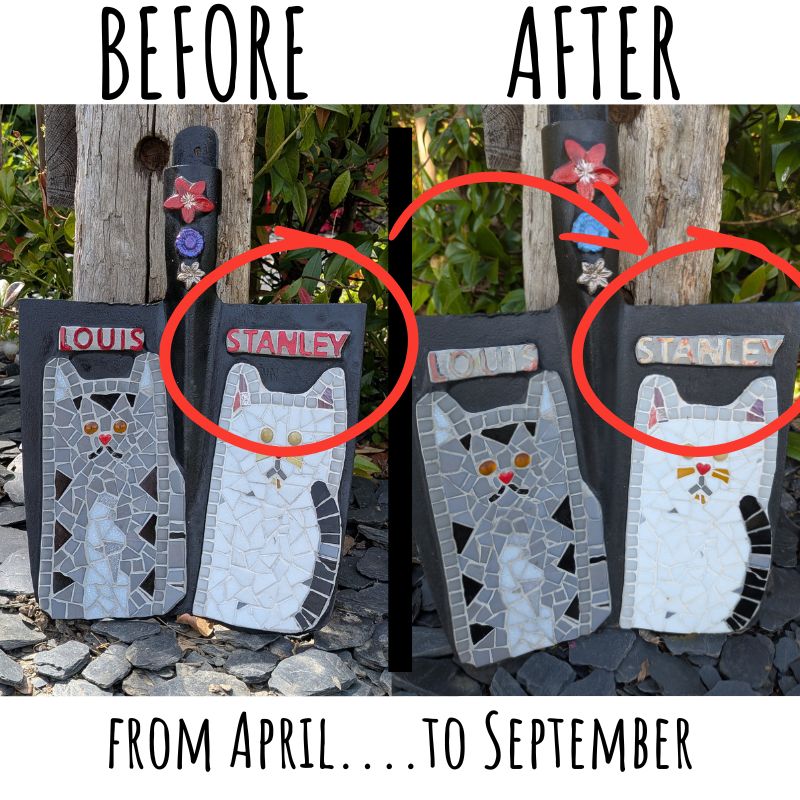
In April, I finished a mosaic I’d made on an old shovel head featuring my Lost Boys design.
Some of the details were painted.
I knew this wasn’t the approach I’d normally choose when making something for long-term outdoor display, but that was precisely why I wanted to do it.
I wanted an example.
Not something I’d read about or been told about — something I’d actually made, put outside and watched over time.
So outside it went.
What happened after only 5 months?
Fast forward to September.
The mosaic has now spent approximately five months outdoors and the difference is already very noticeable.
In particular, the red painted lettering has faded considerably.
We’ve certainly had some unusually harsh conditions here in France this summer. We’ve experienced heatwave after heatwave and a lot of very strong sunshine.
Nevertheless, I was surprised by how much fading had occurred in such a relatively short period of time.
Interestingly, other painted areas haven’t faded nearly as much yet.
And that’s useful too.
I’ll continue watching the piece because I’m interested to see how the different areas change as it spends longer outside.
Does that mean you should never use paint outdoors?
Not necessarily.
This is where I’d make an important distinction.
Something being capable of going outdoors does not automatically make it a durable outdoor solution.
You could paint decorative details on something for your garden and be perfectly happy with the result.
When they eventually fade, you repaint them.
Perhaps touching up the piece every year or two doesn’t bother you at all.
That’s a perfectly valid choice.
The important thing is knowing that you’re making that choice.
How much maintenance do you want?
When I’m planning an outdoor mosaic, one of the things I’m thinking about is what will happen to it long after I’ve finished making it.
It isn’t just:
Will this work?
I’m thinking:
How is this going to perform after a summer outside?
What happens after a winter?
What about repeated changes in temperature?
And how much maintenance am I going to have to do?
Outdoor mosaics have to cope with sunlight, heat, water, frost and repeated temperature changes.
So the choices I make for them are different from those I might make for an indoor mosaic.
Ask a different question
One of the most common questions in outdoor mosaic-making is:
“Can I use this outdoors?”
I think we need to change that question.
Instead ask:
“Is this a good choice for something I want to last outdoors?”
Those two questions can produce very different answers.
There are materials and methods I use specifically because I’m trying to give my outdoor mosaics the best possible chance of surviving outside for the long term.
And that doesn’t just apply to paint.
The materials you choose, what you make your mosaic on, how you prepare it and the methods you use to put everything together all matter.
Those are bigger subjects for another day.
Sometimes you need to test things
For now, my Lost Boys shovel head has become a rather useful teaching tool.
The fading doesn’t bother me — because this was a test.
I wanted a before and after.
I wanted a timeframe.
And now, after just 5 months, I’ve got both.
So if you’re planning your next outdoor mosaic, remember:
Don’t only think about how you’re going to make it look beautiful today.
Think about how you want it to look after it’s spent a year outside.
That one question might change some of the decisions you make before you even begin.