Can You Change a Mosaic Halfway Through? Absolutely.
There is a lovely moment when you’ve planned a new mosaic, chosen your colours and materials and finally start putting everything together.
And then sometimes you look at it and think…
Hmm. That’s not quite right.
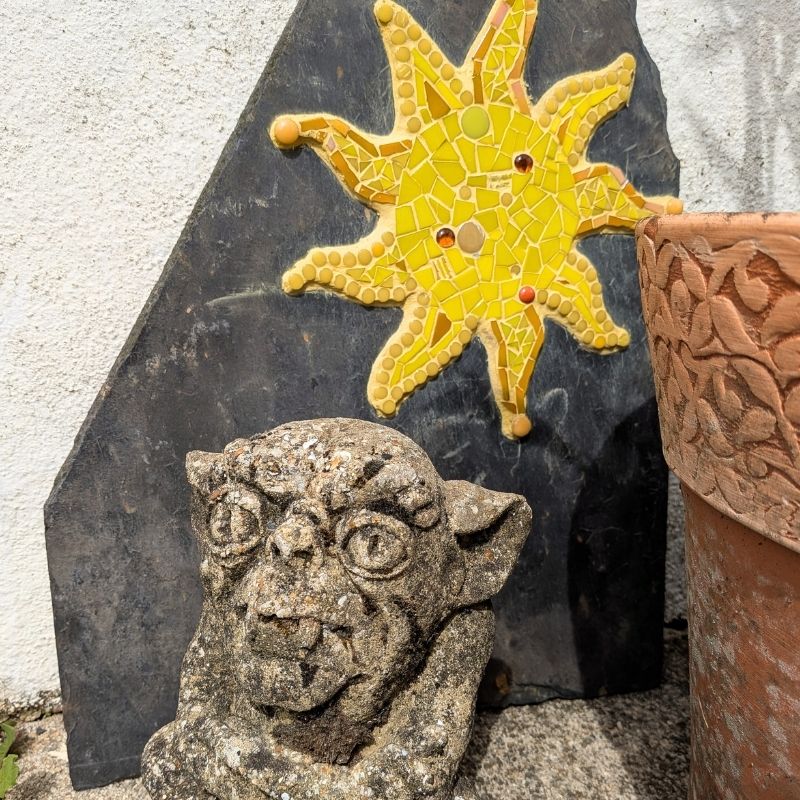
That’s exactly what happened while I was making my recent outdoor sun mosaic.
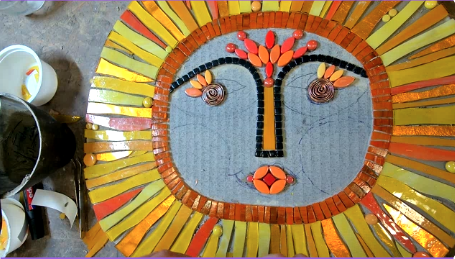
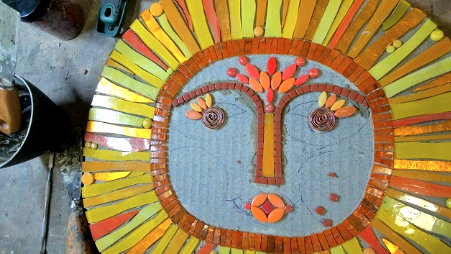
I’d planned the design beforehand and originally used black tile to create the line of the face. But as I added the warm yellow and orange rays around the sun, something changed.
The black suddenly looked too harsh.
It wasn’t technically wrong. It just wasn’t doing what I wanted it to do within the whole mosaic.
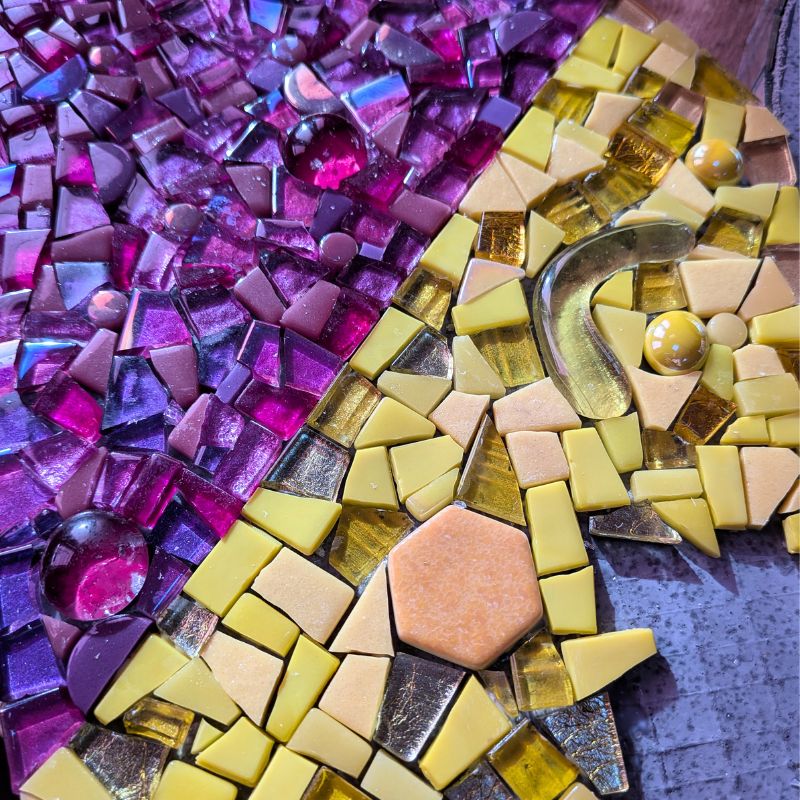
So I took it out and replaced it with brown.
The difference was relatively small, but the softer brown worked much better with the surrounding colours.
And it illustrates something important about mosaic making.
Planning a mosaic doesn’t mean you can’t change the plan
I absolutely recommend planning your mosaics.
Thinking about your design, materials, substrate, adhesive, colours and construction before you begin can prevent a lot of problems later — particularly when you’re making a mosaic for outdoors.
But planning can’t show you everything.
Sometimes you need to see the actual materials together.
Glass reflects light. Colours influence the colours sitting beside them. Lines can become stronger or weaker once the surrounding areas are filled. A colour that seemed perfect when you held one tile in your hand can have a completely different impact when you use 50 of them.
So don’t feel that you have to follow your original plan simply because you’ve started.
Stop making and step away
One of the simplest things you can do while making a mosaic is also one of the most useful:
Stop. Stand up. And take a few steps backwards.
We spend a lot of time looking at mosaics from just a few centimetres away.
From that distance you’re concentrating on individual cuts, gaps, glue and placement.
But that’s rarely how the finished mosaic will be viewed.
Throughout the making process, move away from it and look at the whole composition.
Ask yourself:
– Where does my eye go first?
– Is anything standing out too much?
– Is something disappearing?
– Do the colours still work together?
– Does anything simply feel wrong?
You don’t necessarily need to know immediately why something isn’t working.
Sometimes recognising that something needs changing is enough.
Can you remove tiles after you’ve glued them?
Usually, yes — provided you haven’t grouted yet.
How easy they are to remove depends on the adhesive and substrate you’ve used.
Thinset on tile-backer board or concrete
This is generally the easiest combination to alter.
Tiles can often be carefully lifted or popped away from cured thinset. Remove the remaining adhesive from the area as cleanly as possible before resetting your replacement pieces with fresh adhesive.
PVA
Set PVA can be more awkward.
On wood you’ll need to work carefully, and on foam-core tile-backer board you need to be particularly cautious. Digging too aggressively beneath the tile can damage or gouge the substrate.
A little warm water sprayed onto the dried PVA can help soften it. Give the water time to work rather than trying to force the tile away immediately.
Silicone adhesive
Fully cured silicone is the most difficult to remove, in my experience.
A sharp craft knife or blade can be carefully slid beneath the tile to cut through the silicone.
Take your time and always work carefully when using a blade.
Changing your mind isn’t a mosaic mistake
I think this is the most important part.
Newer mosaic makers can sometimes become very attached to the original plan.
“That’s what I decided, so that’s what I have to do.”
You don’t.
In fact, there’s a point where changing your mind becomes a sign of more confidence, rather than less.
You’ve learned enough to recognise that something isn’t working.
You’ve stopped rather than blindly continuing.
You’ve looked critically at your own work.
And you’ve made a decision about how to improve it.
That’s part of the creative process.
My sun didn’t go wrong because I changed the black line to brown.
Changing it was part of making the sun better.
So plan your mosaic carefully.
Choose appropriate materials.
Think about your colours.
But once you start making, keep looking.
And if your mosaic starts telling you that the original plan needs to change — listen to it.
You may be very glad you did.